EVENT SAFETY: 10 FRESH TIPS FOR KEEPING EVENTS SECURE IN A BRAVE NEW WORLD
Feb
19
2019
White Papers
At big events they can help avert needs for transport and burdening local hospitals
By Kait Shea for Event Marketer
Nearly every city has its own rendition of a marathon, triathlon, extreme obstacle course or swim competition. It is prudent to treat these events, based on their anticipated size, number of participants, and viewing capacity, as predetermined MCIs, each requiring its own disaster plan and risk-mitigation procedures.
Not every mass gathering will become an actual MCI. Fortunately, at fixed venues that host professional sports teams and collegiate sporting events, the patient presentation rate is really predictable and usually low- compared to nonfixed venues where events like music festivals typically take place. While there is always a concern that a mass gathering will become an MCI and/or proper disaster preparedness principles should be employed at every one of the fixed venues hosting sporting events.
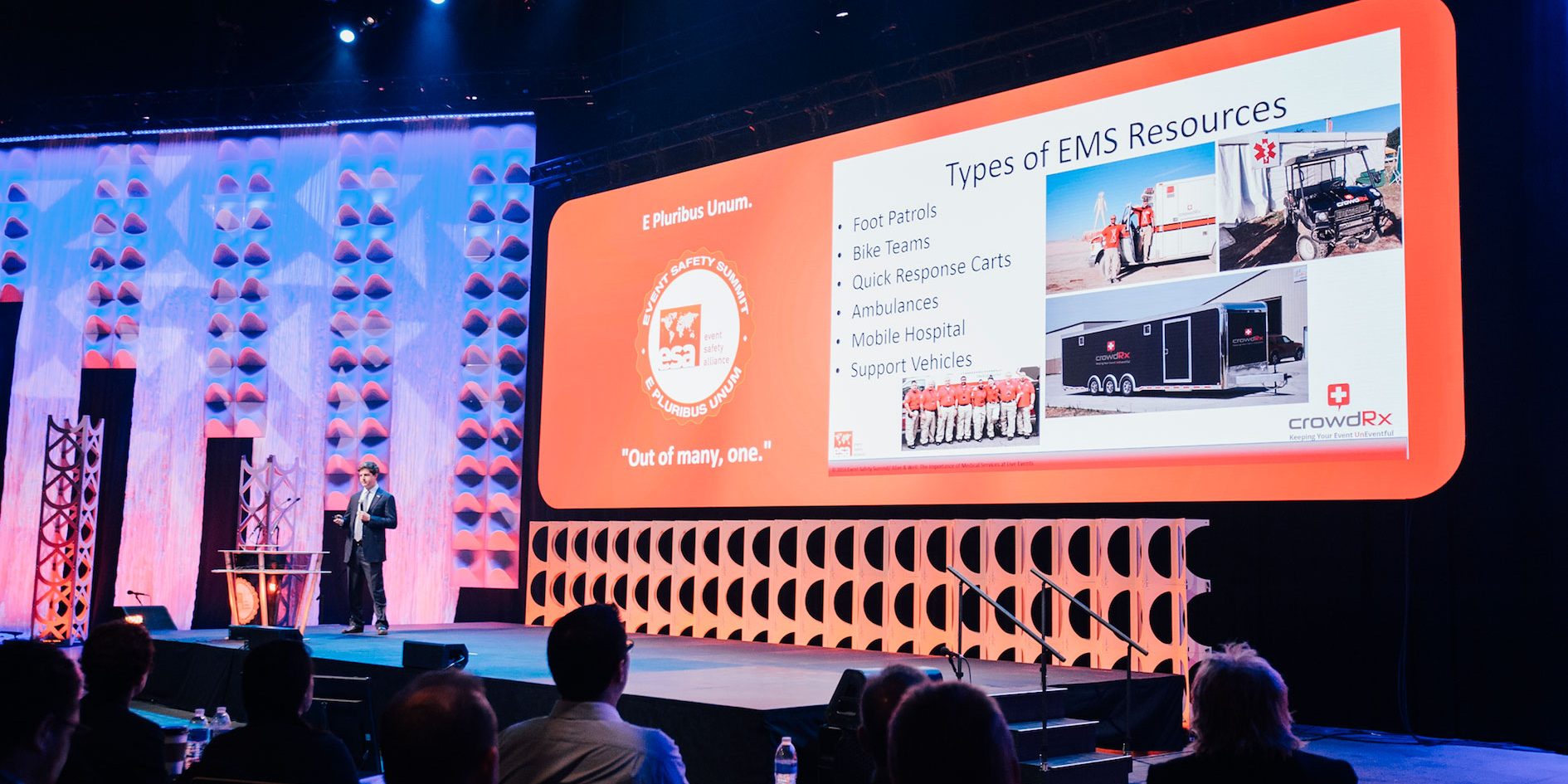
For EMS these events may require enhanced resources and more intense- site preparations. Preventative measures may include multidisciplinary and inter- agency briefing’s, increased numbers of medical staff, and potentially a mobile trailer capable of providing emergency care. The mobile emergency room trailer can have unique benefits at an MCI or mass gathering.
1. Document everything.
You’ll hear it over and over again. In the event of an emergency, especially a medical crisis, documenting the incident is vital to keeping insurance premiums in check and staff informed.
“You want to document everything to make sure your insurance is covered, your event is covered and everyone knows what happened,” says Connor Fitzpatrick, COO at event medical services company.
CrowdRx: “It’s key to remember in medicine; if it’s not documented, it did not happen.” The report can be as simple as a first aid log that may be giving very literal or Band-Aids. Remember to include the name, date of birth, phone number and what the attendee requested or needed. More advanced medical situations call for a detailed patient care report with an indemnity statement. “This is key to make sure your insurance premiums can be reduced as a result,” Fitzpatrick adds.
2. Find a Venue That Prioritizes Attendee Safety.
When it comes to selecting a location for your event, make sure the venue is willing to do its part to communicate key messaging to attendees. Remember: in an incident occurs, cooperation will be key.
“I’ve been to events lately, and you will see at many of these major venues, the venue itself is taking time to express to people, ‘Here’s what you do in the event of a need to clear the facility,’” says Scott Carroll, executive VP at Takel Insurance and secretary of the Event Safety Alliance. “At outdoor events now, announcements are being made ahead of time that if there is an event that requires clearance, here is where you go. In some places, like an open-air field, if a threat every went to come through, the shelter might be this—and this is what the venue would announce—go to your cars. That may be where the safest place is. At most venues, you’re told that now.”
3. Establish a Chain of Command
Sound instinct is a no-brainer, but establishing exactly who is in charge of what and when can save precious minutes in an emergency. From brand managers to medical staff and vendors, everyone should be clear about what their role entails.
“Who makes the final decision-making, who is in charge?” says Shannon Jones, VP at Civic Entertainment Group. “The chain of command at an event needs to follow the broader chain of command in an emergency situation as it relates to the company or brand.”
4. Be Prepared for Anything and Everything.
The uptick in terrorist attacks, including the Las Vegas shooting, which was executed from a hotel room and stands as the deadliest mass shooting in modern U.S. history, has many event marketers on edge. And while planning for these types of crises is essential, don’t assume that past tactics will be used at future events.
“If the bad guy’s weapon of choice is a box truck, or a knife on London Bridge, or some other place where pedestrians are congregating, should there be a change in that?” says Steven Adleman, partner at Adelman Law Group and VP of the Event Safety Alliance. “With the current shiny object—AR15s mounted on tripods on the 32nd story of a hotel—we can’t assume that the next bad guy is going to use the same means of escape as the last one. The weapon of choice may be very different next time.”
5. Implement an Attendee Screening Strategy.
Event planning may vary depending on your budget, but implementing an attendee screening process is a highly effective security measure that can be executed before the event even begins.
“Many events these days, particularly the corporate activation events, are free,” says Anthony Davis, president at AD Entertainment Services. “So, you may have an audience that has not paid an admission or whatever format you use to access them. They’re showing up and we don’t know who they are; they haven’t been pre-screened in terms of their backgrounds. I suggest [using] magnetometers where applicable. Sometimes that’s a challenge due to power. Then, you go a hand-held metal detector wand. And then lastly, if none of those things are available, you do a body check.”
6. Enlist an Approachable Medical Team.
Medical emergencies can, and do, occur at events of every variety, so having medical personnel on-site is crucial, just as important is ensuring that the team is friendly enough for attendees to approach in the case of an emergency. Remember that uniformed first responders can be intimidating, especially in regards to drug-related incidents.
“The medical team should be approachable,” says Fitzpatrick. “There’s a fine balance between a large number of people in a professional uniform where people can trust you and you immediately report and trust report with your attendees, but also, being available and showing that you’re there to help them. Our standard EMS uniform is a red shirt, it’s very non-policelike. The previous way of thinking was very security focused, very police focused. But it’s important to maintain that ‘We’re here to help you’ and your ‘secret is safe with us.’ It’s important that your attendees understand that medical is a judgment-free point.”
7. Keep Security Personnel Informed.
Having security staff is a great way to maintain safety at any event, but communicating your event’s security plans to event attendees is absolutely essential to getting the most bang for your security buck.
“Security personnel should be provided a two-sided information sheet with a site map with the locations of all restrooms; medical tents or areas; stages and activities you’re providing and the schedule of those activities; concession stands and directions to areas where emergency exits are,” says Davies. “Also, you should equip people in services areas with a two-way radio that connects to your designated security manager—you should have someone who is directly responsible for managing security operations.”
8. Let the Pros Do the Talking.
Bad news travels fast, so you have to be clear about who has the authority to deliver crisis communications. (Hint: It’s not the guy handing out samples.)
The people on the ground that are running the event that have the visibility with your audience are your first line of defense in communicating information on a one-on-one or group basis,” says Jones. “It’s important to explain to them and cascade information very quickly with approved language. You don’t want brand ambassadors or event staff taking it upon themselves to communicate what’s going on if there’s some sort of emergency misinformation. The cascade of information in that scenario is really critical as is deciding what they key points are and the information you want them to disseminate.”
9. Implement an Emergency Action Plan.
When it comes to event safety and security, there is probably no more important document than your on-site emergency action plan. It’s an essential guide to navigating and preparing for foreseeable risks, informing event staffers of the appropriate safety protocol and ensuring insurance premiums stay in check.
“If you ask me to try and insure an event for you, one of the things I’m going to ask you about is a site safety plan,” says Carroll. “And I’m going to be asking how [whether or not] you’ve given some thought to this and what your plans are with the site and where the plans associated with what events might happen? Where is your ingress, where is your egress, where are you going to stage security?”
10. Triage Your Risks.
Every live experience is unique, so it’s important to establish priorities for taking action in a variety of emergency scenarios. If you fail to do so, you may find yourself in hot water with your employer, your insurance agency, or even the law.
“Everyone has a common law duty to behave as a reasonable person under the same or similar circumstances,” says Adelman. “That means cognitive thinking in any scenario where the event organizer has to consider the risks, every show, every venue should be the same… An emergency action plan that exists shows that someone knew what was reasonable. A plan that exists that wasn’t implemented establishes the duty of care and also neglect.”
In an industry that prides itself on producing unforgettable experiences, the last thing you want burning in your attendees’ minds is how poorly your staff handled an emergency. So, be informed, be attentive and be prepared—but don’t let the process get you down.
As Davis puts it, “For years we’ve taken it for granted that it’s a fun day, it’s a nice special event, let’s just get out and have fun. And we should still have that mentality. We shouldn’t let recent terrorist acts or potential acts deter us from producing special events. The onus is now on us to be more creative in terms of our staffing.”
Related Posts